How to Choose Zebra Blinds — Fabric, Stripe Width, Color & Motorization Guide
Zebra blinds give you day and night in one blind — but only if you pick the right stripe width, fabric weave, and openness. Complete selection guide with free visualizer that shows day-night alignment on your window.
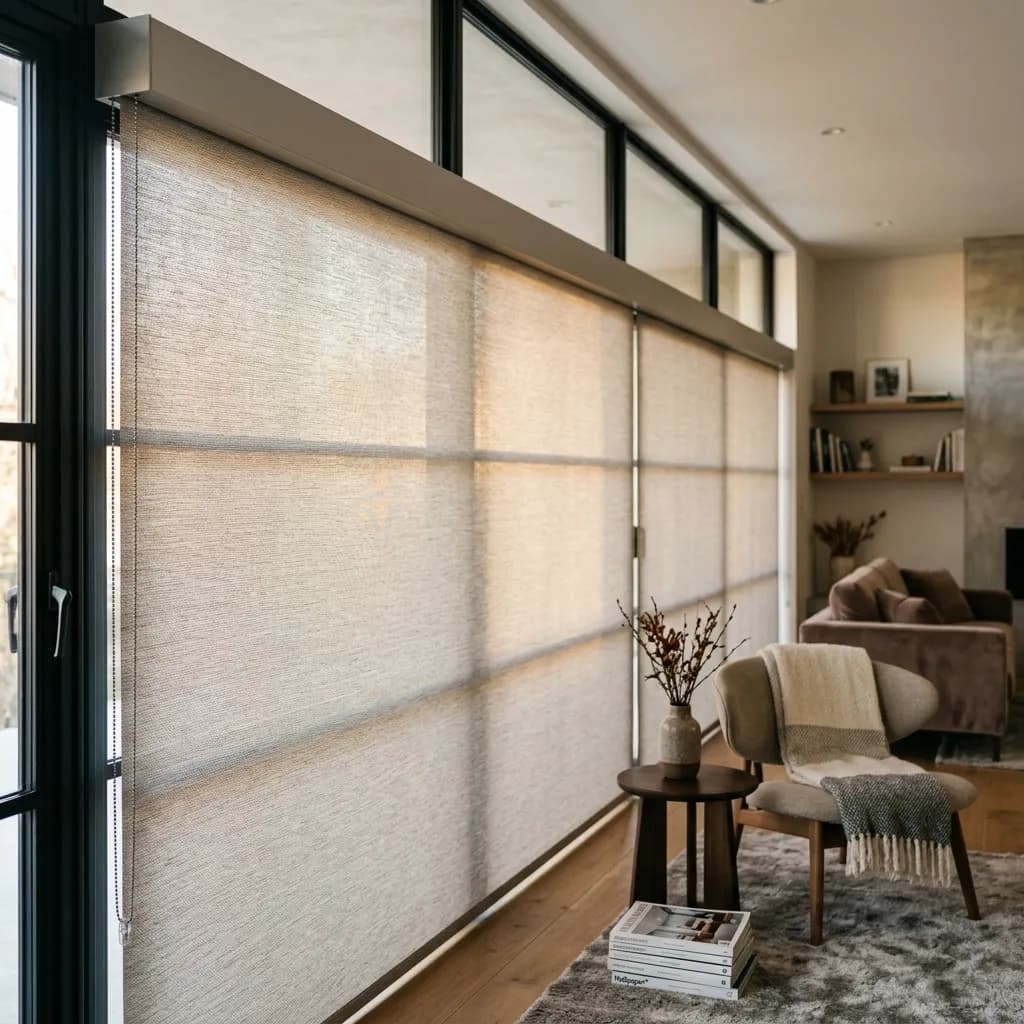
One blind, two positions — day view and night privacy without needing double blinds.
Why Zebra Blinds Became India's Fastest-Growing Blind Category
In 2020, zebra blinds accounted for ~5% of our residential window blind sales in Goa. By 2026, that's jumped to ~28%. The reason: zebra blinds solve the classic 'day OR night' dilemma of single-function blinds.
Roller blinds force you to choose: sunscreen (daytime view, poor privacy) or blackout (nighttime privacy, no daytime view). If you want both, you buy TWO blinds — a sheer roller + a blackout roller on parallel tracks. Cost: double the price + more visual clutter at the window head-rail.
Zebra blinds combine both functions in ONE blind. Pull to align opaque = privacy. Pull to align opaque-on-sheer = view. One mechanism, two modes, adjustable in between.
The trade-offs (which this guide covers):
- ●Zebra costs 30-60% more than single roller blinds
- ●Zebra doesn't achieve total 100% blackout (tiny light bleed through stripe seams)
- ●Not the right choice for every room
By the end of this guide, you'll know:
- 1How zebra blinds work mechanically
- 2Stripe width choice (60mm vs 80mm vs 100mm vs 40mm)
- 3Sheer openness selection (3% vs 10% vs 14%)
- 4Fabric weave and color choices
- 5Motorization decision
- 6Room-by-room zebra vs roller comparison
- 7How to preview YOUR fabric on YOUR window with /tools/zebra-blind-visualizer
How Zebra Blinds Actually Work (Mechanical Explanation)
Two parallel fabric layers hang from the same head-rail:
- ●Front layer: alternating opaque + sheer stripes
- ●Back layer: alternating opaque + sheer stripes
When aligned:
- ●Opaque-on-opaque: light blocked, view blocked = full privacy + shade
- ●Opaque-on-sheer (offset half a stripe): light passes through the sheer + opaque zones alternating = filtered view + light
How you control alignment:
- ●Chain-operated: pull chain to raise/lower the front layer relative to the back. One chain, one continuous action, position anywhere between full-privacy and full-view.
- ●Motorized: press remote button to auto-align to preset positions (privacy, view, custom in-between). Some motors have 'gradual sunrise' modes.
Fabric characteristics:
- ●Both layers are the SAME fabric — the opaque stripes are made of the same dyed fabric with the sheer stripes woven as horizontal windows within the fabric
- ●When you scroll the layers, the sheer 'windows' align with each other for max transparency, or offset to align opaque with opaque for max privacy
- ●The opaque stripes are always 100% opaque
- ●The sheer stripes have their own openness factor (see next section)
Mechanism types:
- ●Chain and cassette: standard mechanism, ₹180-260/sq ft (varies daily)
- ●Cordless spring-lift: no chain, safer for kids/pets, ₹220-300/sq ft
- ●Motorized RF remote: ₹280-380/sq ft including motor cost
- ●Motorized Wi-Fi (Alexa/Google): ₹320-450/sq ft
Preview how sliding layers create day/night in /tools/zebra-blind-visualizer — the tool animates the stripe alignment based on your slider input.
Stripe Width — 60mm, 80mm, 100mm, or 40mm?
Zebra blind fabric comes in different stripe widths — the width of each opaque or sheer band on the fabric. All widths perform identically; this is aesthetic choice only.
60 mm stripes — The Indian standard
- ●Most common in India (approx 65% of orders)
- ●Balanced visual pattern — visible but not overwhelming
- ●Works with any window size from 90 cm to 3 m wide
- ●Universally flattering for most interior styles
- ●Best default if you don't have a strong preference
80 mm stripes — Bold horizontal statement
- ●More visible stripe pattern
- ●Works BEST on wide windows (2 m+) where the pattern has room to 'read' properly
- ●Adds horizontal visual weight — good for making narrow rooms feel wider
- ●Best for: modern living rooms, contemporary bedrooms, hospitality lobbies
100 mm stripes — Modern minimalist maximum
- ●Bold, contemporary look
- ●Best for LARGE picture windows (2.5 m+ wide)
- ●Small windows: pattern looks 'chunky' and out of proportion
- ●Best for: penthouse apartments, modern villa windows, gallery-style spaces
40 mm stripes — Traditional / fine detail
- ●Subtle finer pattern
- ●Works BEST on small windows (under 1.5 m wide) where 60 mm looks too coarse
- ●Traditional and heritage-style interiors
- ●Best for: bathrooms, small bedrooms, offices with compact windows
How to decide:
- ●Compare widths visually in /tools/zebra-blind-visualizer — it renders 4 stripe widths side-by-side on your specific window shape
- ●Or order 4 physical fabric samples (all 4 widths, same color) and hold them against your window
Mixed-width homes:
If you have windows of very different sizes (e.g., large living room + small bathroom), you can mix stripe widths — 80 mm on the large window, 40 mm on the small one — both look proportional to their windows.
Sheer Openness — Same Logic as Roller Blind Sunscreen
The SHEER stripes in a zebra blind have their own openness factor — a percentage of see-through mesh in the sheer band. This ONLY affects the 'view' alignment position; the 'privacy' position stays 100% opaque regardless.
3-5% openness sheer — Strong glare reduction
- ●Even in 'view' position, glare is heavily reduced
- ●Outside view is muted (you see building outlines, not details)
- ●Best for: bedrooms wanting some daytime light without full brightness, west-facing living rooms with harsh afternoon sun
10% openness sheer — The standard living room choice
- ●Balanced view retention with soft light diffusion
- ●You can see outside clearly with slight softening
- ●Best for: living rooms, dining rooms, home offices, most residential windows
- ●DEFAULT choice for most Indian homes
14% openness sheer — Maximum view retention
- ●View is very clear (like looking through fine mesh)
- ●Glare only moderately reduced
- ●Best for: garden-facing dining rooms, sunroom windows with beautiful garden/sea views, ground-floor rooms with landscaping to enjoy
Choosing openness by room use:
- ●Bedroom → 3-5% (privacy prioritized even in view mode)
- ●Living room → 10% (balanced)
- ●Kitchen → 10% (visibility important)
- ●Home office → 5-10% (monitor glare control)
- ●Dining room facing view → 14% (view is the feature)
- ●Bathroom → 3% (privacy priority)
Preview openness levels in /tools/zebra-blind-visualizer — slide between 3%, 10%, and 14% on the same fabric color to see the difference.
Fabric Color — What Works with Zebra Design
Zebra blind fabrics come in a curated color range because the striped pattern reads best in certain tones:
Highly recommended for zebra:
- ●White / off-white — cleanest look, maximum diffusion in view mode
- ●Cream / ivory — warm neutral, universal
- ●Sand / beige — warm modern, hides dust
- ●Light grey / silver — modern minimalist standard
- ●Champagne / mushroom — sophisticated warm neutral
- ●Taupe / greige — trendy warm-cool blend
Works well but check pattern impact:
- ●Charcoal / dark grey — dramatic modern look, but stripe pattern is more visible than in light colors
- ●Dark taupe / mocha — warm dramatic, works in formal rooms
Available but less popular:
- ●Navy blue — pattern very visible; best in nautical/coastal themes
- ●Emerald green — bold; only in modern accent rooms
- ●Burgundy / wine — traditional formal; heritage settings only
Generally avoided:
- ●Bright reds, oranges, yellows — pattern feels overwhelming
- ●Pure black — shows every dust particle in the stripe grooves
Two-tone zebra blinds (specialty):
Some premium zebras have contrasting opaque and sheer stripe colors — e.g., off-white opaque + soft grey sheer. Creates subtle visual interest. Add approx ₹40/sq ft. Best for design-forward interiors.
Color choice by room:
- ●Master bedroom → cream, taupe, warm grey (calming)
- ●Living room → white, sand, light grey (versatile)
- ●Home office → charcoal, silver (professional)
- ●Dining room → champagne, taupe (elegant)
- ●Kitchen → white (visibility)
- ●Bathroom → white, silver (fresh)
Preview colors on your specific window in /tools/zebra-blind-visualizer — 40+ colors rendered on YOUR room and window shape.
Zebra vs Roller vs Vertical — When to Choose Each
Compare zebra against alternatives:
Zebra wins when:
- ●You want DAY VIEW + NIGHT PRIVACY from one blind
- ●Modern minimalist aesthetic desired
- ●Window is moderate width (1.5-2.5 m ideal)
- ●Adjustable partial-privacy positions matter (not just fully-open or fully-closed)
- ●Budget is not the primary constraint (zebra 30-60% pricier than roller)
Roller wins when:
- ●Budget-conscious (₹75-220/sq ft vs zebra ₹180-320/sq ft)
- ●Need TOTAL blackout (zebra has minor light bleed at stripe seams)
- ●Only need ONE function per window (sunscreen only OR blackout only)
- ●Simpler mechanism preferred
- ●Larger fabric/color variety wanted (roller has more options)
Vertical wins when:
- ●Very wide windows (over 2.5 m — zebra becomes structurally unstable at large widths)
- ●Sliding patio doors or floor-to-ceiling windows
- ●Budget-conscious wide-window solution
- ●Traditional or commercial aesthetic acceptable
Wooden Venetian wins when:
- ●Premium executive/formal look required
- ●Adjustable tilt-angle privacy matters (rotate slats 45° for filtered light + privacy)
- ●Warm natural material aesthetic desired
- ●Dry room (not bathroom/kitchen — real wood warps)
Combination approach (common in premium homes):
- ●Living room → zebra (day/night flexibility)
- ●Master bedroom → roller blackout (dedicated blackout function)
- ●Kids room → cordless roller (safety)
- ●Dining room → zebra or wooden Venetian (formal presentation)
- ●Kitchen → PVC roller (waterproof)
- ●Study/office → zebra or roller (concentration + occasional view)
Try all types on your window in our visualizer tools:
Motorization Decision — When Zebra Motors Are Worth ₹3,500-6,000
Motorized zebra blinds cost ₹3,500-6,000 extra per window (varies daily by motor grade). Here's when it pays off:
Motorize IF any of these apply:
- 1High window (above 8 ft): chain is out of reach without a stool
- 2Master bedroom: 'gradual sunrise' mode wakes you naturally
- 3Executive cabin / boardroom: impresses clients, professional feel
- 4Skylight or hard-to-reach installation: chain isn't practical
- 5Smart-home integration desired: Alexa/Google voice control
- 6Multiple windows needing group control: single button raises/lowers all zebras in room simultaneously
- 7Living room with 3+ zebras: motorized-group control keeps mornings consistent
Skip motorization when:
- ●Single easy-to-reach window
- ●Budget-tight
- ●Guest rooms or occasional-use rooms
- ●Bathroom or kitchen (rare operation)
Motor tiers:
- ●Basic RF remote motor (+₹3,500): press button, blind moves. Preset positions programmable.
- ●Wi-Fi motor (+₹5,000-6,000): control from phone app, scheduling, geofencing
- ●Wi-Fi + Alexa/Google (+₹6,000-8,000): voice commands 'Alexa, close bedroom zebra'
- ●Somfy silent premium motor (+₹8,000-10,000): whisper-quiet, best-in-class reliability, 5-year warranty
Power options:
- ●Hard-wired to mains (best for new construction — plan during electrical work)
- ●Rechargeable Li-ion battery (recharge every 6-12 months via USB-C)
- ●Solar panel add-on (zero maintenance for sunlit windows)
Group control setup:
- ●Program 3-5 zebras to respond to same remote button = 'all bedroom windows close together'
- ●Program room-based groups (all living room, all master bedroom)
Practical recommendation for Indian homes:
- ●Motorize: master bedroom + primary living room windows
- ●Manual chain: guest rooms, kids rooms, kitchen, bathroom, offices
- ●This splits your motor budget across the highest-value windows (~40% of your total zebra count)
Ready to Visualize? Use Our Free Zebra Blind Visualizer
You now know how to spec zebra blinds. The fastest way to see YOUR fabric on YOUR window: /tools/zebra-blind-visualizer.
What the visualizer does uniquely for zebra:
- 1Enter your window dimensions
- 2Pick stripe width (40mm, 60mm, 80mm, 100mm) — see pattern impact on your window size
- 3Pick fabric color (40+ options rendered accurately)
- 4Slide between DAY-VIEW and NIGHT-PRIVACY positions — see the layer alignment animate in real time
- 5Toggle sheer openness (3% / 10% / 14%) — see how much view/light comes through in view mode
- 6Room lighting simulation — bright day, evening, night for realistic preview
- 7Compare 2-4 fabric/stripe combos side-by-side
How to use (5-10 minutes):
- 1Open /tools/zebra-blind-visualizer
- 2Enter window width × drop
- 3Try 3 stripe widths — save the one that looks proportional
- 4Cycle through favorite colors on the saved stripe width
- 5Test the day-night slider on top 2 favorites
- 6Screenshot final choice
WhatsApp us for confirmation:
+91 9579542260 — send:
- ●Visualizer screenshot with your saved fabric/stripe/color
- ●Window dimensions
- ●Whether motorized or manual desired
We respond within 2 hours with:
- ●Physical fabric swatches (free, refundable ₹0 deposit)
- ●Approximate quote (final varies daily by fabric price)
- ●Free measurement visit in Goa
Related tools:
- ●/tools/blind-size-calculator — final pricing for your window
- ●/tools/roller-blind-visualizer — compare with single-function roller blinds
Related reading:
- ●/blog/zebra-blinds-living-room-lighting — zebra blinds in living room context
- ●/blog/types-of-blinds-complete-guide-india-2026 — all 8 blind types compared
- ●/blog/how-to-measure-windows-for-blinds-inside-outside-mount-india — measurement guide
- ●/blog/how-to-choose-roller-blind-fabric-color-guide-india — roller blind alternative
Need Custom Blinds Collection?
Order custom dimensions online for Pan-India delivery, or book a free site consultation in Goa with our senior decor team.
Frequently Asked Questions
How do zebra blinds work?
Zebra blinds have TWO layers of horizontally-striped fabric — each layer has alternating OPAQUE and SHEER stripes. When you pull the chain (or press motorized button), the two layers slide up/down relative to each other. When opaque aligns with opaque = full privacy + darkness. When opaque aligns with sheer (offset) = full view + light. In between = adjustable filtering. One blind provides both a daytime 'view' position and a nighttime 'privacy' position without needing two blinds.
Zebra blinds vs roller blinds — which is better?
Zebra blinds: TWO functions in one blind (day/view + night/privacy), modern minimalist aesthetic, best day-night flexibility, but 30-60% more expensive than roller blinds and slightly less blackout than dedicated blackout roller. Roller blinds: single function (sunscreen OR blackout), lower cost, better full blackout, larger fabric variety. Choose zebra when: you want day AND night from ONE blind, modern minimalist look, single-mechanism convenience. Choose roller when: budget-conscious, need full blackout for bedroom, or want a fabric roller can't replicate.
What stripe width should I choose for zebra blinds?
Standard zebra blind stripe widths: (1) 60 mm stripes — most common in India, balanced day-night effect, works with any window size; (2) 80 mm stripes — bolder horizontal pattern, works better on wider windows (2 m+); (3) 100 mm stripes — modern minimalist look, best for large picture windows and modern interiors; (4) 40 mm stripes — subtle finer pattern, best for small windows (under 1.5 m wide) and traditional interiors. All widths function identically — this is purely aesthetic choice. Compare widths visually in /tools/zebra-blind-visualizer.
What fabric openness should zebra blind sheer stripes have?
The SHEER stripes in zebra blinds have their own openness factor: (1) 3-5% openness sheer — strong glare reduction with tiny view; best for bedrooms; (2) 10% openness sheer — balanced view + glare reduction; best for living rooms (STANDARD choice); (3) 14% openness sheer — clearest view with minimal glare reduction; best for garden-facing rooms with beautiful views. The OPAQUE stripes remain 100% opaque regardless. Openness only controls the 'view' position — pull down to align opaque-on-opaque for full privacy always.
Are motorized zebra blinds worth the extra cost?
Motorized zebra blinds add approx ₹3,500-6,000 per window (varies daily by motor type). Worth it when: (1) Window is above 8 ft height (hard to reach chain); (2) Master bedroom (wake to gradual sunrise mode); (3) Executive cabin (impresses clients); (4) Skylight or hard-to-reach installation; (5) You want smart-home integration (Alexa/Google voice control). Skip motorization when: window is reachable, budget-conscious, chain operation is acceptable. Most Indian homes benefit from motorizing MASTER bedroom + LIVING ROOM zebra blinds, leaving guest rooms and offices as manual chain.
More on blinds
Roller Blinds for Windows Price India (2026): Solar Screen, Blackout & Motorization Guide
8 min read

Zebra Blinds for Living Room: Dual-Layer Light Control, Prices & Motorization Guide
7 min read
Monsoon Blinds for Balconies: Waterproof PVC & Bamboo Roll-Down Protection Guide
7 min read