How to Measure Windows for Blinds — Step-by-Step Guide with Free Size Calculator
Measure once, order right. Complete guide to inside-mount and outside-mount blind measurements — width, drop, tolerance, deductions — plus a free calculator that prices your exact window in seconds.
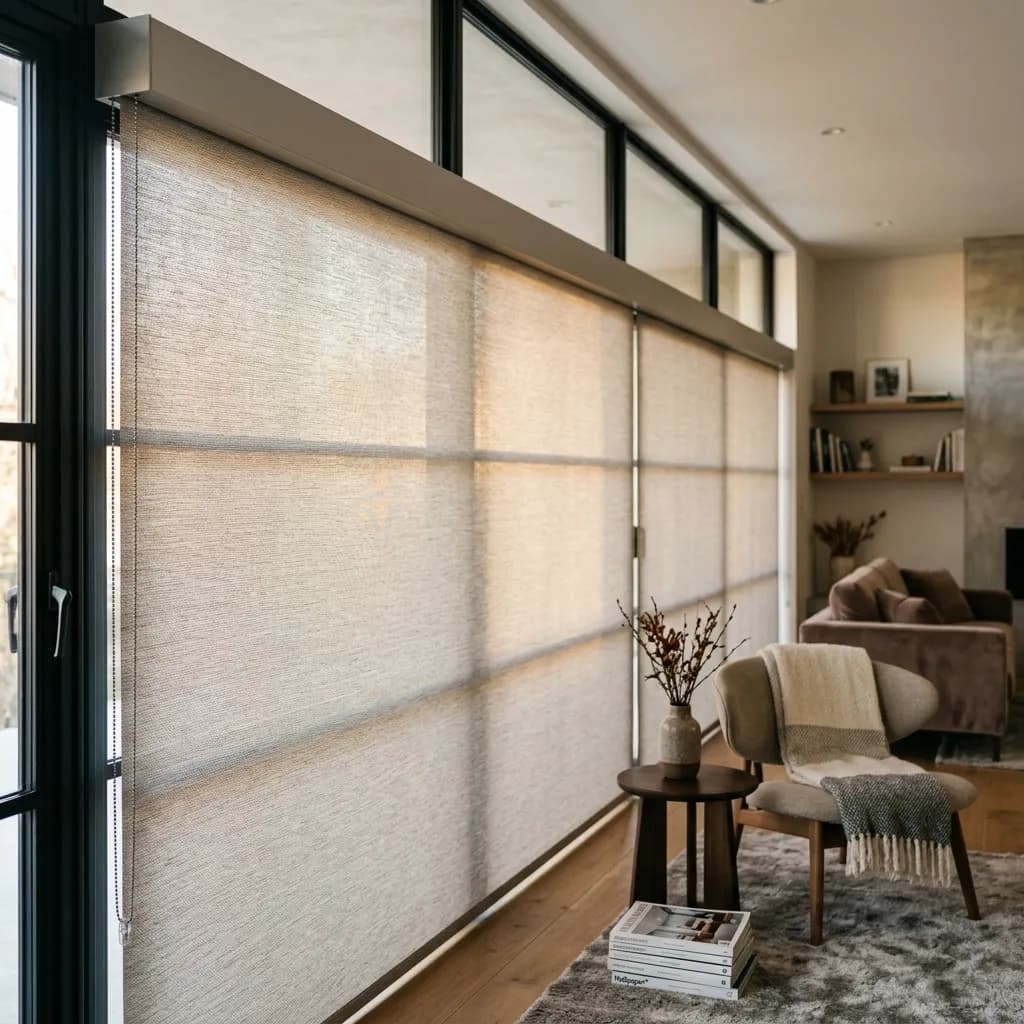
Getting measurements right is the difference between a perfect fit and a costly re-order.
Why Getting Blind Measurements Right Matters (The ₹5,000-15,000 Mistake)
A blind ordered 5 mm too wide won't fit into the recess — you'll have to send it back or drill new outside-mount holes into your wall. A blind ordered 3 cm too narrow for outside-mount will let light bleed through the sides, defeating the entire point of a blackout in your bedroom. In both cases, you've paid for a custom-cut product that can't be returned for a refund — factories will only offer a discounted re-order at ~40-60% of original price. That's ₹5,000-15,000 lost on a single window.
This guide walks through exactly how to measure any window for blinds, using the same methods our team uses when we do free on-site measurement across Goa. By the end you'll know:
- 1What tools you need (spoiler: not much)
- 2Inside-mount vs outside-mount — how to decide
- 3Exactly how to measure each type
- 4Factory deduction rules (why you should NEVER pre-deduct yourself)
- 5Common mistakes that cost people thousands
The fastest way to price your measurements: our /tools/blind-size-calculator takes your window dimensions and shows instant per-sq-ft pricing across all our blind fabrics and mechanisms — no signup, no wait.
Tools You Need (3 Items, All Under ₹500)
You need only 3 things to measure a window for blinds professionally:
1. Metal retractable tape measure (min 5 metre / 16 ft length) — approx ₹150-350. NEVER use a fabric tailor's tape — it stretches by 3-8 mm over long measurements. NEVER use a phone AR measurement app — those are off by 1-3 cm which is enough to ruin an inside-mount blind. The metal Stanley/Fastrack tape is the right tool.
2. Notebook + pen — record dimensions in millimeters (mm), not centimeters. mm gives you the precision blind factories need. Bedroom window: '1247 mm W × 1568 mm H' (correct) is better than '124.7 cm × 156.8 cm' (rounded, ambiguous).
3. Step stool or short ladder — for windows above eye level. Measuring on tiptoes gives crooked readings.
Optional (nice-to-have): A small torch to check inside deep recesses, a right-angle set square to check if window corners are truly 90°.
Don't need: Laser measures (overkill for one-off use), spirit levels (the factory calibrates to your measurements), professional survey tools.
Once you have measurements, feed them into /tools/blind-size-calculator for instant pricing across all our fabric options.
Step 1: Decide Between Inside Mount and Outside Mount
Before measuring, decide the mounting type — because measurements differ.
Inside Mount (aka 'recess fit' or 'reveal fit'):
The blind mounts INSIDE the window recess (the frame surrounding your window opening). Head-rail sits against the top of the recess. Sides tuck between the two vertical frame edges.
Choose inside mount if:
- ●Your window recess is at least 5 cm (2 inch) deep — minimum for the head-rail to sit fully inside
- ●Your window frame is attractive (wood, painted metal, textured) — worth showing
- ●You want a clean, minimalist, integrated look
- ●You have decorative crown molding or cornices above the window that a wall-mount would clash with
Outside Mount (aka 'exact fit' or 'face fit'):
The blind mounts on the WALL above and beside the window. Head-rail brackets attach to the wall (or ceiling for deep-drop windows). Blind fabric overlaps the window opening completely.
Choose outside mount if:
- ●Recess is less than 5 cm deep (can't fit head-rail inside)
- ●Your window frame is ugly (rusted metal, weathered wood, damaged)
- ●You need maximum blackout — light bleeds through inside-mount side gaps
- ●Your window is uneven (older houses) — outside mount hides the unevenness
- ●You want the window to appear larger — extend blind 10-15 cm past frame on each side
Still unsure? Send us a photo of your window on WhatsApp +91 9579542260 with a tape measure held against the recess depth — we'll advise the right mount type within 2 hours.
Step 2: Measuring for Inside Mount (The Recess Fit)
Width (3 measurements):
- 1Measure the INSIDE recess width at the TOP (right where the head-rail will sit)
- 2Measure the INSIDE recess width at the MIDDLE (halfway down the window)
- 3Measure the INSIDE recess width at the BOTTOM (near the sill)
Record all 3 in mm. Use the SMALLEST of the 3 readings as your ordering width. Window recesses are rarely perfectly rectangular — even 3-5 mm variation is common. Using the smallest guarantees the blind slots in cleanly.
Drop / Height (3 measurements):
- 1Measure recess height on the LEFT edge (top of recess to sill)
- 2Measure recess height in the CENTER
- 3Measure recess height on the RIGHT edge
Use the SMALLEST reading as your ordering drop, OR the LONGEST if you want the blind to reach exactly to the sill without gap (personal preference — most customers use smallest for safety).
Recess depth check:
Measure how deep your recess is (from window glass to front wall edge). Minimum 5 cm (50 mm) for standard blinds; 6-8 cm ideal. If under 50 mm, switch to outside mount.
Do NOT deduct anything from your measurements. Give the factory the EXACT recess width and drop — the factory automatically deducts 6 mm each side for roller/zebra/Venetian blinds (12 mm total) or 20-30 mm each side for vertical blinds (40-60 mm total). If you pre-deduct AND the factory deducts, your blind will be too narrow.
Enter your measurements in /tools/blind-size-calculator — the tool applies the correct deduction per blind type automatically and shows exact final sizes + prices.
Step 3: Measuring for Outside Mount (The Wall Fit)
Width:
1. Measure the width of the window OPENING (frame to frame, or glass edge to glass edge if no frame) 2. Add extension for coverage: • Standard coverage: add 5 cm (50 mm) on each side → total = opening + 10 cm • Blackout coverage (bedroom): add 8 cm (80 mm) on each side → total = opening + 16 cm • Maximum coverage (light control priority): add 10 cm on each side → opening + 20 cm 3. Your final width order = opening + total extension
Drop / Height:
1. Measure the height of the window OPENING (top of frame to bottom of frame) 2. Add extension for coverage: • Top: mount head-rail 10-15 cm ABOVE the window frame (helps blackout, blocks top light bleed) • Bottom: extend fabric 5-10 cm BELOW the window sill for overlap • Total added = 15-25 cm on the drop
Wall clearance check:
Before ordering, verify you have at least 10 cm of clear wall above the window (or the ceiling itself) for the bracket screws. Blocked by AC unit or cornice? Consider ceiling-mount brackets (+₹200-500 upgrade).
Motorized blinds:
Motorized outside-mount blinds need clearance for the motor housing (usually 6-8 cm deep protruding from the wall). Verify no obstructions.
Enter your outside-mount measurements in /tools/blind-size-calculator — select 'outside mount' and the tool computes bracket placement and gives you exact ordering dimensions + price.
Step 4: Special Cases — Deep Recesses, Bay Windows, Sliding Doors
Deep recess windows (15+ cm depth):
Inside-mount fine, but consider these options:
- ●Recess-mount with light-blocking side channels — small aluminum tracks along both sides that seal the blind flush to the recess wall, blocking side-light bleed. Adds ~₹500/blind.
- ●Or double-mount: sheer roller INSIDE recess + blackout roller OUTSIDE recess for full day-night control.
Bay windows (angled or curved 3-5 panel windows):
Measure EACH panel separately (typically 3-5 measurements). Use inside-mount on each panel. The blinds operate independently. Some bay windows benefit from motorized operation (one remote controls all 3-5 blinds at once).
Special for bay: measure the ANGLE between panels — some panels aren't quite 90° or 135°. Send this angle to the factory so brackets can be angled if needed.
Sliding patio doors (wide openings):
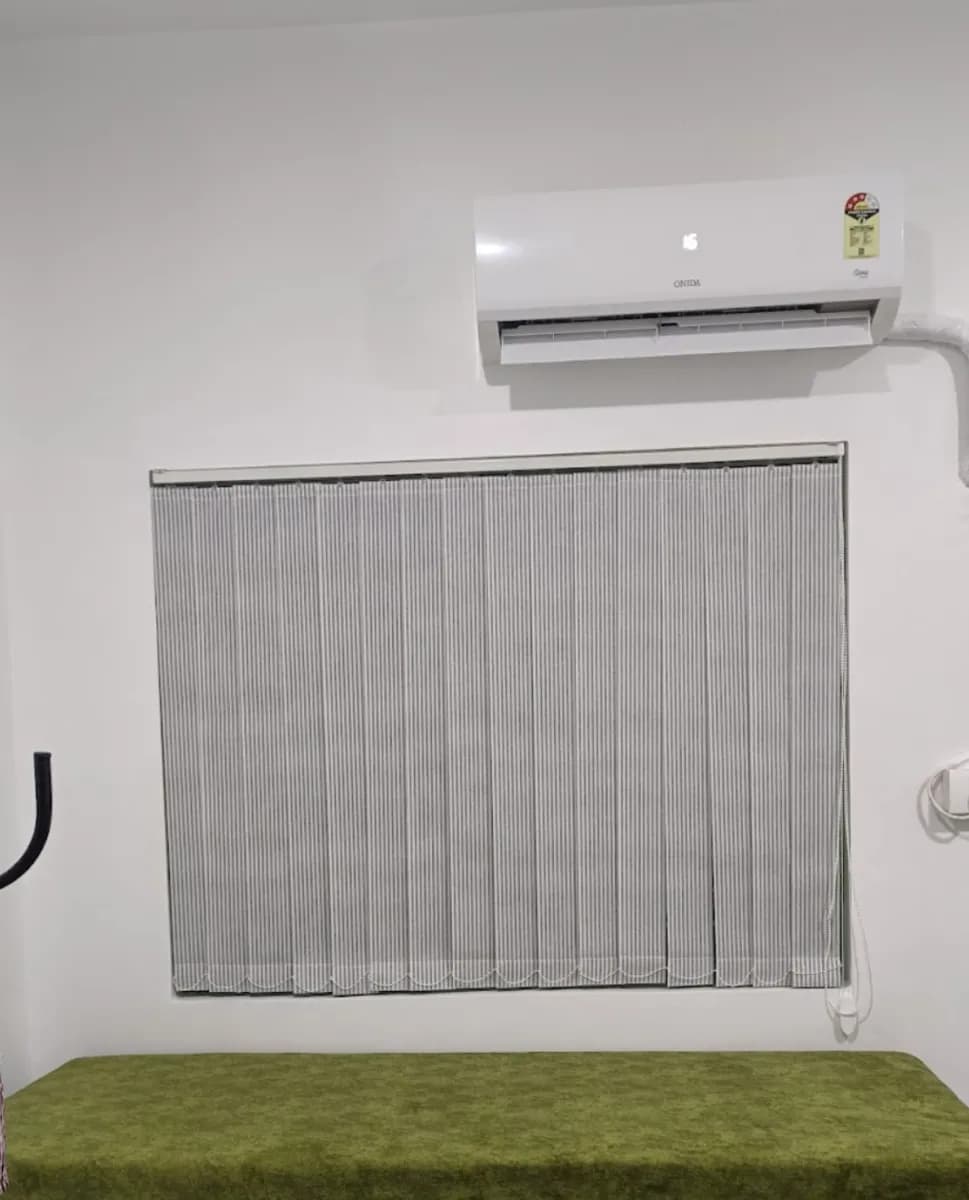
- ●Vertical blinds are the standard — measure the FULL width of the door track + 10-20 cm on each side for stack-back clearance
- ●Or panel-track blinds (2-4 sliding fabric panels) — measure width + choose panel count
- ●Or wide vertical zebra (motorized) — measure width, but note the 8-9 ft width limit per single blind (wider = split into 2 blinds)
French doors (double-hinged glass doors):
- ●Outside-mount full-width blind OR one inside-mount blind PER door leaf (both open together)
- ●Consider the door swing — inside-mount blinds move WITH the door; outside-mount stays on the wall
Skylights and roof windows:
- ●Motorized required (can't reach the chain manually)
- ●Cellular/honeycomb blinds recommended (thermal insulation)
- ●Special mounting — factory measurements only; contact us for quote
Step 5: Recording Your Measurements Correctly
Standard format (India): `Width × Height` in millimeters (mm). Always mm — not cm, not inches.
Example correct format:
Bedroom Window 1 — INSIDE MOUNT
Width: 1247 mm (smallest of 1252/1249/1247)
Drop:  1568 mm (smallest of 1571/1570/1568)
Recess depth: 75 mm (OK for inside mount)
Blind type: Roller blackout
Living Room Window 2 — OUTSIDE MOUNT
Window opening: 1800 × 1500 mm
Ordering size: 1900 × 1650 mm (added 50mm each side; +100mm top, +50mm bottom)
Blind type: Zebra sheer
Naming convention: Label each window clearly by ROOM + POSITION — 'Master Bedroom North', 'Living Room Bay Left', 'Kids Room Small'. When you order 6 blinds, this prevents mix-ups at delivery.
Save the measurements: Take a photo of your notebook OR type them into your phone Notes app. Send to installer/factory when ordering. Keep for future reference — if the blind ever needs replacement in 10-12 years, the measurements are still valid.
Digital option: Enter every window into /tools/blind-size-calculator — the tool stores each window's dimensions in your session and computes total order value + per-window prices. Screenshot the results and send on WhatsApp for a quote.
Common Mistakes That Cost People Thousands
Mistake #1: Only measuring in one spot. Window recesses are almost never perfectly square. Even 5-8 mm variation between top and bottom is normal in Indian apartments. If you measure only the top, and the bottom is 8 mm narrower, your inside-mount blind won't fit. Always measure 3 spots.
Mistake #2: Fabric tape measure. Tailor's soft tapes stretch by 3-8 mm over the length. That's enough to make an inside-mount blind too tight OR an outside-mount blind leave a light gap. Use only a metal retractable tape.
Mistake #3: Confusing width and height on the order. Blind orders always list Width × Height (W × H). If you swap them, the factory cuts a 1500 mm wide × 1200 mm tall blind when you meant 1200 wide × 1500 tall. Always label 'W' and 'H' clearly.
Mistake #4: Pre-deducting for inside-mount. People measure recess = 1250 mm, then order 1240 mm 'so it fits'. But the factory ALSO deducts 12 mm. Result: 1228 mm blind with 22 mm side gap. Give the factory the EXACT recess width — they handle deductions.
Mistake #5: Ignoring recess depth. Ordering inside-mount for a 3 cm deep recess = head-rail protrudes 2 cm out of the recess = ugly, may not close properly. Verify minimum 5 cm depth OR switch to outside mount.
Mistake #6: Measuring over handles or protrusions. Some window handles or latches stick out 1-2 cm into the recess. Measure AROUND them at the narrowest point, OR install outside-mount to avoid the issue entirely.
Mistake #7: Not accounting for outside-mount wall clearance. Ordering outside-mount for a window with AC unit directly above = brackets can't attach. Check clearance above the window BEFORE ordering.
Mistake #8: Using rounded cm instead of exact mm. Rounding 1247 mm → 125 cm loses 3 mm precision. That's enough for gaps or interference. Always mm.
Ready to Order? Use Our Free Blind Size Calculator
Once you have measurements, don't guess prices — get exact ones. Our /tools/blind-size-calculator does 4 things:
1. Instant price by blind type: Enter your window in mm, pick blind type (roller, zebra, Venetian wooden/PVC/aluminum, vertical, cellular), and the tool shows per-sq-ft price × your area = total in rupees. Compare 5 blind types side-by-side.
2. Automatic deduction application: Enter EXACT recess width for inside-mount and the tool applies the correct factory deduction per blind type (6 mm for roller/zebra/Venetian, 30 mm for vertical). No manual math.
3. Outside-mount coverage calc: Enter window opening + coverage level (standard, blackout, maximum) and the tool computes ordering dimensions and mounting bracket position.
4. Multi-window totals: Add all your home's windows one by one. Tool builds a per-window price breakdown and grand total. Screenshot for a WhatsApp quote.
When you're ready to order:
- 1Fill measurements → /tools/blind-size-calculator
- 2Screenshot the price breakdown
- 3WhatsApp +91 9579542260 with the screenshot + your address
- 4Free measurement visit across Goa (Panjim, Margao, Mapusa, Vasco, Ponda) — we double-check with laser measure and install
- 5Pan-India: we ship pre-made blinds cut to your measurements in 5-7 days
Try each blind type visually first:
- ●/tools/roller-blind-visualizer — preview roller blinds in your fabric/color
- ●/tools/zebra-blind-visualizer — preview zebra day-night alignment
- ●/tools/vertical-blind-visualizer — preview vertical blinds for wide windows
Related reading: /blog/types-of-blinds-complete-guide-india-2026 (choose which blind type first), /blog/blinds-for-office-best-window-blinds-workplace-india-2026 (office setups), /blog/monsoon-balcony-blinds-rain-protection (weather-facing windows).
Need Custom Blinds Collection?
Order custom dimensions online for Pan-India delivery, or book a free site consultation in Goa with our senior decor team.
Frequently Asked Questions
How do I measure a window for blinds accurately?
Use a metal tape measure (not fabric), measure width in 3 places (top, middle, bottom) and drop in 3 places (left, center, right). For INSIDE-mount: take the SMALLEST of the 3 width readings; standard factory deduction is ¼ inch (6 mm) on each side. For OUTSIDE-mount: add 5-8 cm to width and 10-15 cm to drop for full coverage & light-blocking overlap. Record both dimensions in mm. Use our /tools/blind-size-calculator to convert into instant price.
Inside mount vs outside mount blinds — which should I choose?
INSIDE mount (blind fits inside the window recess): clean, minimalist look, shows off window frame, no wall-drilling above/beside window. Needs at least 5 cm (2 inch) recess depth for the head-rail. Best for modern homes with proper window recesses. OUTSIDE mount (blind mounts on the wall above/around window): maximum light block (no side gaps), fully covers ugly frames, works when recess is too shallow or uneven. Best for bedrooms wanting blackout, and older/uneven windows.
What deduction should I make when ordering inside-mount blinds?
Standard factory deductions for inside-mount blinds: (1) Roller & Zebra blinds: ¼-inch (6 mm) deducted from width on each side (12 mm total) by the manufacturer — you provide the EXACT recess width; (2) Venetian blinds: 6 mm each side deduction; (3) Vertical blinds: 20-30 mm each side (vane clearance). Never deduct yourself — ALWAYS give the actual recess measurement. The factory deducts based on blind type. Enter your window in /tools/blind-size-calculator and the tool applies the correct deduction automatically.
How much extra should I add for outside-mount blinds?
For outside-mount (wall mount) blinds: (1) Width: add 5-8 cm on each side of the window opening (10-16 cm total) — this ensures full light-block coverage and hides the frame; (2) Drop: add 10-15 cm at the top (mounted 10-15 cm above frame) + 5-10 cm at the bottom for overlap. Total drop = window height + 15-25 cm. For bedroom blackout, add 10 cm on all sides. Wall-mounted brackets need at least 10 cm of clear wall above the window for the head-rail.
What are the most common blind measurement mistakes to avoid?
Top mistakes: (1) Measuring only ONE spot — window frames are rarely square; measure 3 spots for width AND drop, use smallest for inside-mount; (2) Using fabric/cloth tape — it stretches and gives wrong readings; (3) Confusing width and height on the order form — always label W × H clearly; (4) Not checking recess depth — need 5+ cm for inside-mount; (5) Measuring over handles, latches, or protrusions instead of the actual glass; (6) Rounding measurements — always record in mm (millimeters), not rounded cm. Use our /tools/blind-size-calculator to validate before ordering.
More on blinds
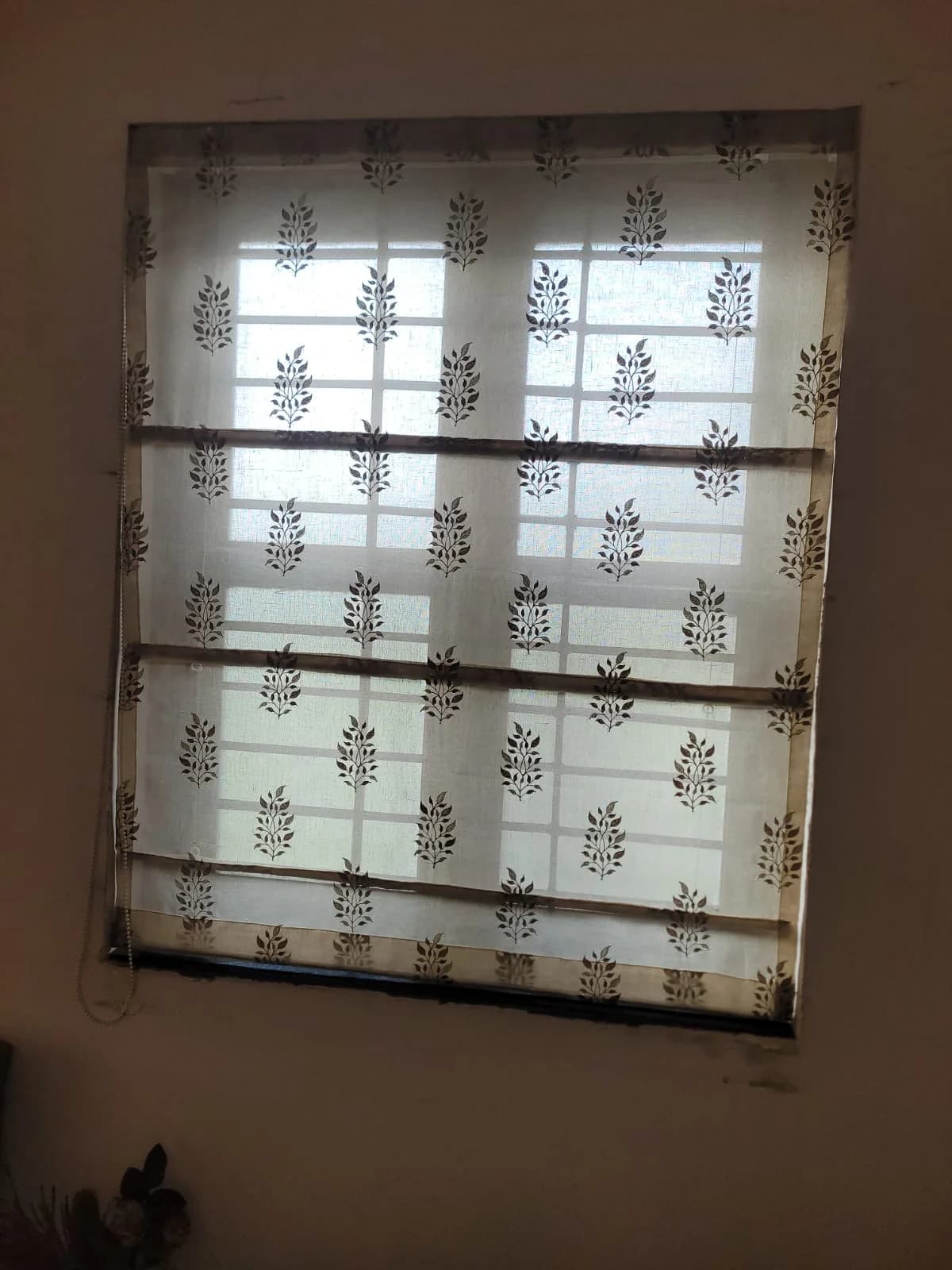
Roller Blinds for Windows Price India (2026): Solar Screen, Blackout & Motorization Guide
8 min read

Zebra Blinds for Living Room: Dual-Layer Light Control, Prices & Motorization Guide
7 min read
Monsoon Blinds for Balconies: Waterproof PVC & Bamboo Roll-Down Protection Guide
7 min read