How to Calculate Curtain Fabric — Complete Meters & Yardage Formula with Free Calculator
The exact formula stitchers use to convert your window width and drop into fabric meters — plus fullness ratios, pattern-repeat rules, hem allowances, and a free calculator that does the math for you.

Get the formula right once — save yourself from ordering too much or too little fabric.
Why Calculating Curtain Fabric Matters (₹8,000-25,000 in Waste)
Order too much fabric: you've paid for 4-6 meters you don't need. At approx ₹850-1,850 per meter for premium fabric, that's ₹5,000-11,000 wasted per window.
Order too little: your curtain looks thin (insufficient fullness), doesn't reach the sill (short drop), or has visible unmatched seams (fabric cuts don't align). Fixing this means buying additional fabric from a different dye batch — which usually shows color variation. Or scrapping and starting over. Cost: ₹8,000-25,000 per window redo.
This guide walks through:
- 1The exact formula tailors use
- 2Fullness ratios per pleat style
- 3Fabric roll width impact (54 inch vs 108 inch)
- 4Pattern repeat math
- 5Header + hem allowances
- 6Lining fabric calculations
- 7How to skip the math entirely (spoiler: use /tools/curtain-fabric-calculator)
By the end you'll either know the formula cold, OR know exactly what to input into our free calculator for instant results.
The Core Formula — Written in Plain English
Step 1: Compute number of fabric 'cuts' (panels) needed
(Track Width × Fullness Ratio) ÷ Fabric Roll Width = Number of Cuts
Round UP to next whole number — you can't buy half a cut.
Example: 3-metre wide track × 2.5× fullness ÷ 1.37 m fabric roll = 5.47 cuts → round up to 6 cuts.
Step 2: Compute cut length
Finished Drop + 35 cm (15 top + 20 bottom hem) = Cut Length
Example: 2.4 m finished drop + 0.35 m allowances = 2.75 m per cut.
Step 3: Compute total fabric meters
(Number of Cuts × Cut Length) = Total Meters
Example: 6 cuts × 2.75 m = 16.5 metres of fabric needed.
Step 4: Add pattern repeat adjustment (if applicable)
If your fabric has a printed/woven vertical pattern (e.g., 40 cm repeat), each cut length must be rounded UP to the nearest multiple of 40 cm:
2.75 m cut → nearest 40 cm multiple = 2.8 m per cut → 6 × 2.8 = 16.8 m total. Pattern repeat adds 5 cm here (~1.8% more fabric).
Formula summary in one line:
Meters = ceil((Track × Fullness) / RollWidth) × ceil((Drop + 0.35) / PatternRepeat) × PatternRepeat
Prefer to skip the math? /tools/curtain-fabric-calculator does all of this in one screen — enter track width, drop, fabric width, pleat style, and pattern repeat, and it outputs the final fabric meters instantly.
Fullness Ratios — Match the Pleat Style to the Right Number
Fullness ratio = total fabric width ÷ finished curtain width. Higher ratios = fuller gathers = richer drape but more fabric.
2.0× fullness — Casual, budget-friendly
- ●Eyelet curtains (grommet-top) — grommet holes create natural minimum gathers
- ●Pencil-pleat curtains (basic gathered tape header)
- ●Best for: guest bedrooms, home offices, sheer daytime layers, budget projects
- ●Fabric usage: minimum (30-40% less than luxury pleats)
2.2-2.3× fullness — Wave / S-fold drapery (motorized)
- ●Modern minimalist wave header on ripple-fold track
- ●Fabric hangs in continuous S-curves
- ●Best for: modern minimalist living rooms, motorized master bedroom tracks
- ●Fabric usage: medium
2.5× fullness — Triple pinch pleat (formal)
- ●Traditional 3-fold pinch pleat header (each pleat uses 3 folds of fabric)
- ●Rich, formal, layered drape
- ●Best for: formal drawing rooms, master bedrooms, luxury master suites, hospitality suites
- ●Fabric usage: standard-premium
3.0× fullness — Sheer curtains only
- ●Sheers look thin and 'stringy' at lower ratios
- ●3× fullness gives sheers the elegant flowing drape they need
- ●Best for: sheer daytime layer, formal double-track setups
- ●Fabric usage: highest (sheers are cheap so total cost stays reasonable)
Fullness in practice: A 3-metre wide window:
- ●2.0× fullness = 6 metres of fabric width laid flat = 4-5 cuts of 54" fabric
- ●2.5× fullness = 7.5 metres of fabric width = 5-6 cuts
- ●3.0× fullness = 9 metres of fabric width = 6-7 cuts
The fullness choice cascades — one small setting changes total fabric by 30-40%.
Fabric Roll Width — 54 inch (Standard) vs 108 inch (Seamless)
The fabric ROLL width determines how many vertical cuts you need to stitch together to span your window.
Standard 54-inch (137 cm) fabric rolls:
- ●Fabric runs VERTICALLY — each 137 cm panel is one 'cut'
- ●For wide windows, multiple cuts are stitched together (visible vertical seams every 137 cm)
- ●MOST affordable — largest selection of fabrics available in this width
- ●Best for: budget projects, average width windows, when fabric variety matters more than seamless appearance
Extra-wide 108-inch or 118-inch (274-300 cm) seamless fabrics:
- ●Fabric runs HORIZONTALLY along your track — the roll's WIDTH becomes your curtain's HEIGHT
- ●Zero vertical seams — one continuous curtain surface
- ●Premium look — no visible stitching lines
- ●Requires that your finished drop is LESS than roll width (i.e., drop < 274 cm for 108" fabric)
- ●Fabric selection more limited (specialty rolls)
- ●30-50% more expensive per meter — but LESS TOTAL meters needed for average windows
When each wins on cost:
- ●Small window (2m wide × 2m drop): 54" is cheaper (2 cuts × 2.35 m each = 4.7 m at ₹850/m = ₹4,000). 108" needs ~5 m at ₹1,275/m = ₹6,375. 54" wins.
- ●Large window (4m wide × 2.5m drop): 54" needs 7-8 cuts × 2.85 m each = 20-23 m at ₹850/m = ₹17,000-19,500 + higher stitching cost. 108" needs 4m × ~1 continuous roll cut = ~4 m at ₹1,275/m = ₹5,100 + minimal stitching. 108" wins big.
Threshold: Windows wider than ~3.5m often favor 108" seamless. Narrower windows favor 54".
Our /tools/curtain-fabric-calculator compares both roll widths side-by-side — enter your window, see the meter and cost for each, pick the winner.
Pattern Repeat — The Hidden Fabric Multiplier
If your fabric has a printed OR woven pattern (florals, damasks, geometrics, jacquards, printed cottons), the pattern must ALIGN across adjacent cuts. Adjacent panels stitched together look like a single continuous pattern.
How pattern repeat works:
A fabric might have a 40 cm vertical pattern repeat — every 40 cm along the fabric length, the pattern restarts. When you cut two panels for stitching:
- ●Cut #1: starts at 0, ends at 2.75 m (your cut length)
- ●Cut #2 must start at a matching pattern point — so it might need to start at 0.40 m of the roll, wasting the first 40 cm
The rule: each cut length must be a MULTIPLE of the pattern repeat (rounded UP).
Example:
- ●Cut length needed: 2.75 m
- ●Pattern repeat: 60 cm (0.6 m)
- ●Nearest multiple of 0.6 above 2.75 = 3.0 m (5 × 0.6)
- ●Every cut becomes 3.0 m instead of 2.75 m
- ●6 cuts × 3.0 m = 18 m instead of 16.5 m
- ●Extra fabric due to pattern: 1.5 m (approx 9% more)
Typical pattern repeat values:
- ●Small florals: 15-25 cm
- ●Medium damask/geometric: 30-50 cm
- ●Large florals or feature patterns: 60-90 cm
- ●XXL grand-scale prints: 100 cm+
Impact on cost: Pattern repeat typically adds 5-20% more fabric.
Plain fabrics (no pattern): no adjustment needed. Cuts fit exactly as calculated.
Sheers (usually plain): no pattern adjustment usually needed.
Prefer to skip the math? /tools/curtain-fabric-calculator has a pattern repeat field — enter it and the tool applies rounding automatically.
Hem Allowances — Why 35 cm Gets Added to Every Cut
Every cut length adds 35 cm to your finished drop for professional tailoring:
Top allowance: 15 cm
- ●Fold-over for the header — depending on pleat style, this creates the pleat structure
- ●Includes buckram (stiffener strip) fold
- ●Includes heading tape allowance (pinch pleat tape, eyelet tape, wave tape etc.)
- ●Small allowance for stitching
Bottom allowance: 20 cm (double 10 cm hem)
- ●Standard master-tailor practice: double-fold the bottom for weighted drape
- ●First fold: 10 cm up
- ●Second fold: 10 cm up over the first fold
- ●Creates a heavy weighted bottom that hangs straight, doesn't flap or curl
- ●Cheaper single-fold hems (10 cm total) exist but look flimsy and hang crooked over time
Total per cut = Finished Drop + 35 cm
Example: 2.4 m finished drop → 2.75 m cut length
Optional weighted hem:
For curtains that need to hang perfectly still (formal drapes, motorized wave curtains):
- ●Add lead weight tape inside the double hem (adds ~₹50/m)
- ●Weight tape helps the curtain hang plumb even in AC airflow
Optional heading enhancements (some styles need +5 cm to top allowance):
- ●Tab-top: 5 cm extra for tab loops
- ●Rod pocket: 3 cm extra for pocket
- ●Grommet/eyelet: 2 cm extra for reinforcement strip
Our /tools/curtain-fabric-calculator applies these allowances automatically based on the pleat style you select — no need to remember which allowance goes where.
Lining Fabric — The Second Meter Calculation Most Guides Forget
If you want your curtains lined (which we recommend for most bedrooms and formal rooms), you need to calculate lining fabric SEPARATELY from the face fabric.
Why line curtains:
- ●Blackout lining: blocks 90-100% light (bedroom essential)
- ●Thermal lining: reduces AC cooling loss + insulates against outside heat
- ●Acoustic lining: dampens 8-12 dB of outside noise
- ●Fabric protection: lining sits between sun and your expensive face fabric, extending face fabric life 30-50%
- ●Better drape: lined curtains hang heavier and more elegantly
Lining calculation:
Lining fabric roll widths and cuts are USUALLY the same as face fabric (both are typically 54" / 137 cm):
Lining Meters = Face Fabric Meters − Pattern Repeat Extra
(Lining has no pattern, so no pattern repeat adjustment needed.)
Example:
- ●Face fabric: 18 m (6 cuts × 3 m with pattern repeat rounding)
- ●Lining: 16.5 m (6 cuts × 2.75 m — plain, no rounding)
Lining fabric options (approximate 2026 India prices, vary daily):
- ●Basic blackout polyester lining: approx ₹180-250/m
- ●Premium 3-pass blackout: approx ₹380-550/m
- ●Thermal-blackout combo: approx ₹450-650/m
- ●Acoustic + thermal + blackout: approx ₹650-950/m
Optional 'interlining' layer (for ultra-premium curtains):
A THIRD fabric layer between face and lining — soft cotton fleece or bump cloth for maximum drape, thermal, and acoustic performance. Approx ₹280-450/m. Doubles the lining meter calculation.
Our /tools/curtain-fabric-calculator has a lining toggle — enable blackout/thermal/acoustic lining and the tool outputs both face fabric AND lining meters separately, plus lining cost per your fabric choice.
Worked Example — 3-Metre Living Room Window, Triple Pinch Pleat
Let's calculate fabric for a real Indian living room window from start to finish:
Given:
- ●Track width: 3.0 m
- ●Finished drop (track to floor): 2.4 m
- ●Fabric: Belgian linen, 137 cm roll, plain (no pattern)
- ●Fabric price: approx ₹850/m (varies daily)
- ●Pleat style: triple pinch pleat (2.5× fullness)
- ●Lining: standard blackout polyester at ₹250/m
Step 1: Number of cuts
(3.0 × 2.5) ÷ 1.37 = 5.47 → round up = 6 cuts
Step 2: Cut length
2.4 + 0.35 = 2.75 m per cut
Step 3: Face fabric meters
6 × 2.75 = 16.5 m of Belgian linen
Step 4: Face fabric cost
16.5 × ₹850 = ₹14,025 (approximate)
Step 5: Lining meters (same as face, no pattern)
6 × 2.75 = 16.5 m of blackout lining
Step 6: Lining cost
16.5 × ₹250 = ₹4,125 (approximate)
Step 7: Heading tape (2.5× fullness triple pinch pleat)
Heading tape ≈ track width × fullness = 3.0 × 2.5 = 7.5 m of pinch pleat tape at ₹60/m = ₹450
Step 8: Stitching + hem work (approx)
Professional master tailor stitching: ₹1,800-2,500
Total curtain cost (approximate):
| Item | Cost |
|---|---|
| Face fabric (16.5m Belgian linen) | ₹14,025 |
| Blackout lining (16.5m) | ₹4,125 |
| Pinch pleat heading tape (7.5m) | ₹450 |
| Stitching + finishing | ₹2,200 |
| Grand total | ₹20,800 |
Prices vary daily by fabric, market rates, and current stock. Add motorized track (₹8,000-15,000) if desired.
Our /tools/curtain-fabric-calculator does this entire calculation in one screen — enter track, drop, pleat style, fabric price, and lining choice, get instant total. Screenshot for a WhatsApp quote to confirm today's exact fabric prices.
Skip the Math — Use Our Free Curtain Fabric Calculator
You now understand the formula. The fastest way to apply it: our /tools/curtain-fabric-calculator.
What the calculator does:
- 1Cuts calculation with fullness ratio auto-applied per pleat style
- 2Cut length with hem allowances auto-added
- 3Pattern repeat rounding when you enter repeat size
- 4Face fabric meters for both 54" and 108" fabric widths
- 5Lining meters if you select blackout/thermal/acoustic lining
- 6Heading tape meters and cost
- 7Total cost estimate based on typical fabric prices (verify exact rates on WhatsApp for today's quote)
How to use it (60 seconds):
- 1Open /tools/curtain-fabric-calculator
- 2Enter track width in metres (e.g., 3.0)
- 3Enter finished drop in metres (e.g., 2.4)
- 4Select pleat style (2.0× eyelet, 2.5× triple pinch, 3.0× sheer, etc.)
- 5Select fabric roll width (137 cm standard OR 274 cm seamless)
- 6Enter pattern repeat if applicable (0 cm for plain fabrics)
- 7Toggle lining (blackout / thermal / none)
- 8See instant results: fabric meters, lining meters, tape length, cost
Save the results:
Screenshot the output. Send on WhatsApp +91 9579542260 with your window measurements — we confirm today's fabric prices, propose fabric options, and quote motorized/manual track cost separately.
Related tools you'll want next:
- ●/tools/curtain-cost-estimator — quick fabric + stitching + hardware total
- ●/tools/fabric-care-guide — how to care for your chosen fabric long-term
- ●/curtains — browse our fabric collections (sheer/blackout/linen/velvet/printed)
Related reading: /blog/types-of-curtains-complete-guide-india (choose fabric first), /blog/curtains-for-bedroom-complete-buying-guide-india (bedroom-specific advice), /blog/blackout-curtains-bedroom-light-control (blackout deep-dive).
Need Custom Curtains Collection?
Order custom dimensions online for Pan-India delivery, or book a free site consultation in Goa with our senior decor team.
Frequently Asked Questions
How much fabric do I need for curtains?
The formula: (Track Width × Fullness Ratio ÷ Fabric Roll Width) = number of cuts. Then (Number of cuts × Cut Length) ÷ 100 = total meters. Cut length = finished drop + 35 cm (15 cm top header + 20 cm double bottom hem). Standard fullness: 2.0× (basic), 2.5× (triple pinch pleat/luxury). Standard fabric roll: 137 cm (54 inch) or 300 cm (108 inch seamless). Use our /tools/curtain-fabric-calculator to skip the manual math.
What is the right fullness ratio for curtains?
Fullness ratio = how much fabric width you use vs the finished curtain width. (1) 2.0× fullness — casual, budget, eyelet or pencil-pleat curtains. Clean gathers without excess bulk. (2) 2.2-2.3× fullness — wave/S-fold drapery on motorized tracks. Modern minimal look. (3) 2.5× fullness — triple pinch pleat, luxurious rich gathers. Best for formal living rooms, master bedrooms. (4) 3.0× fullness — sheer curtains only (sheers look thin at lower ratios). Higher fullness = more fabric = more cost but richer drape.
What extra fabric do I need for hems, headers, and pattern repeat?
Standard tailor allowances: (1) Top header + buckram fold: 15 cm (6 inch) added to cut length; (2) Double bottom hem (weighted): 20 cm (8 inch) — folded twice for hang; (3) Total per cut length = finished drop + 35 cm; (4) Side hems: 4 cm each side, factored into fullness math. Pattern repeat adjustment: if fabric has a printed/woven pattern, EACH cut length must be rounded UP to the nearest multiple of the vertical pattern repeat. Typical repeat = 30-60 cm; this adds 10-20% more fabric. Our /tools/curtain-fabric-calculator applies pattern repeat automatically.
What's the difference between 54-inch and 108-inch fabric?
54-inch (137 cm) fabric: STANDARD roll width. Panels are stitched vertically to span wider windows — each 137 cm panel is one 'cut'. Creates vertical seams down the curtain (visible if you look closely). Most affordable, widest fabric selection. 108-inch or 118-inch (274-300 cm) SEAMLESS fabric: extra-wide roll runs HORIZONTALLY along your track (roll width = curtain height). Zero vertical seams — one continuous curtain. Premium look, best for luxury spaces. Typically 30-50% more expensive per meter but no stitching seams and less total fabric for average windows.
Can I calculate curtain fabric myself, or do I need help?
You can — if you're comfortable with the formula (track × fullness ÷ roll width = cuts; cuts × cut length ÷ 100 = meters) AND you remember pattern repeat adjustments AND lining fabric calculations AND hem allowances. Most homeowners find it easier to use our /tools/curtain-fabric-calculator — enter track width, drop, fabric width, pleat style, and pattern repeat, and it outputs exact fabric meters + lining meters + heading tape meters + estimated cost in seconds. Free, no signup.
More on curtains
100% Blackout Curtains for Bedroom India: Light Blocking, Thermal Fabric & Price Guide
8 min read
Curtain Fabric Types & Material Guide: Sheer, Velvet, Linen & Blackout Fabrics
8 min read
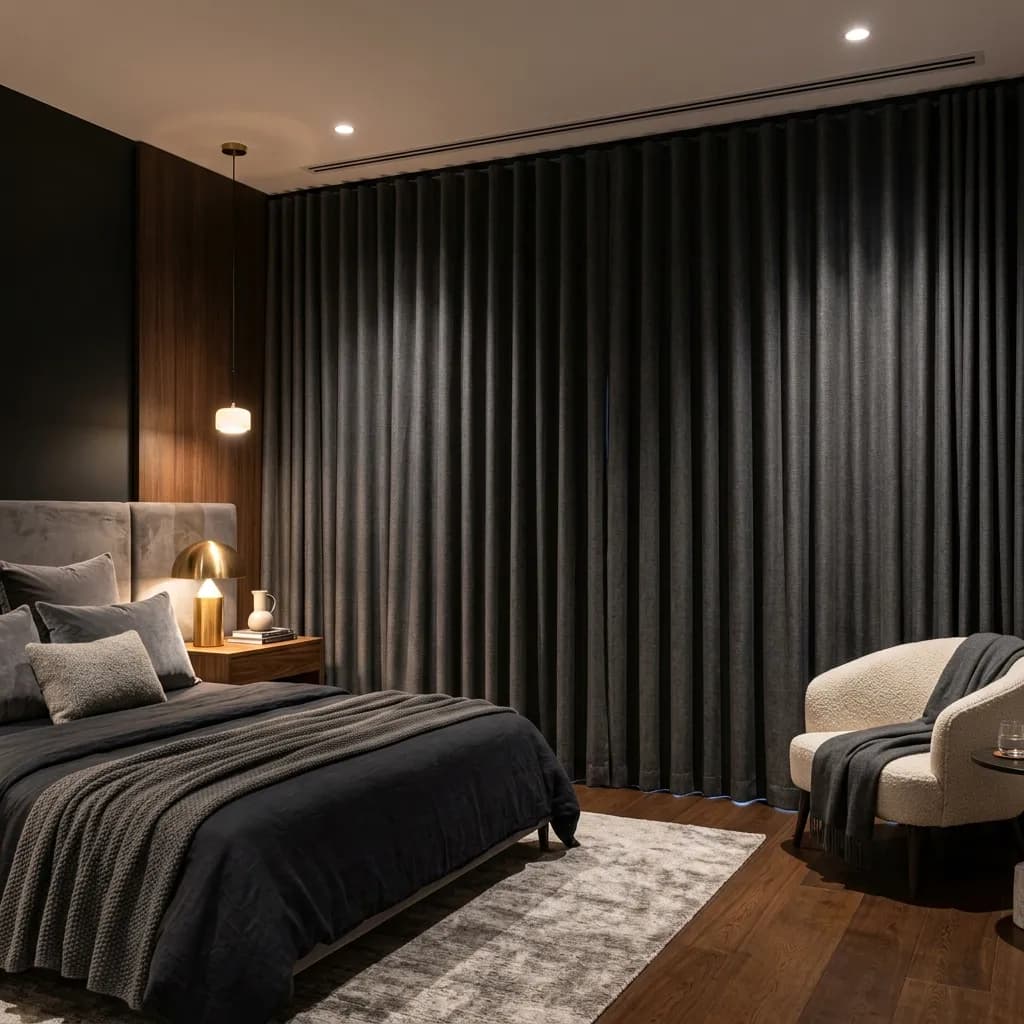
Curtains for Bedroom — Complete 2026 Buying Guide for Indian Homes (Fabric, Style, Blackout, Measurements)
12 min read