Curtains for Bedroom — Fabric, Style, Blackout & Measurement Guide
Which curtain fabric, colour, blackout level and pleat style matches your bedroom? Room-darkening tips, coastal-humidity fabrics, single vs double-track setups, and how to measure — the complete guide.
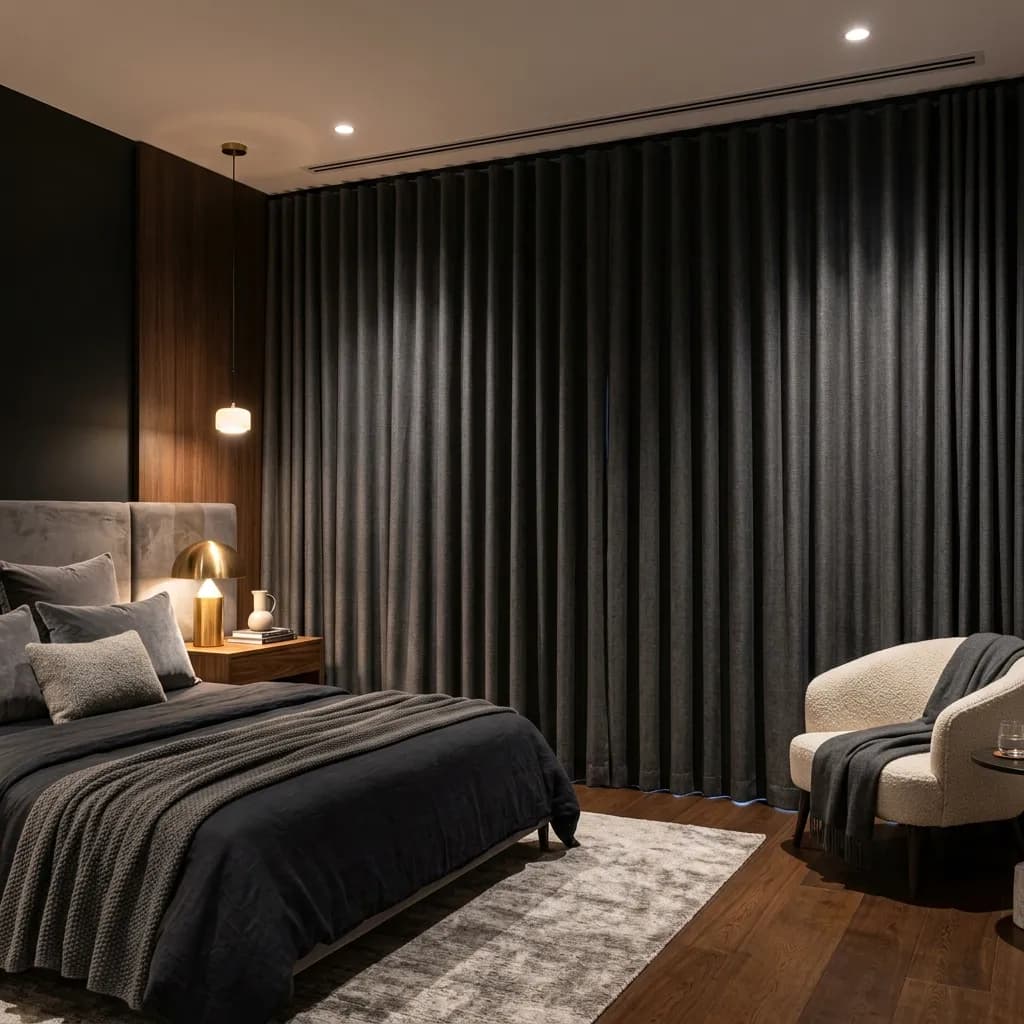
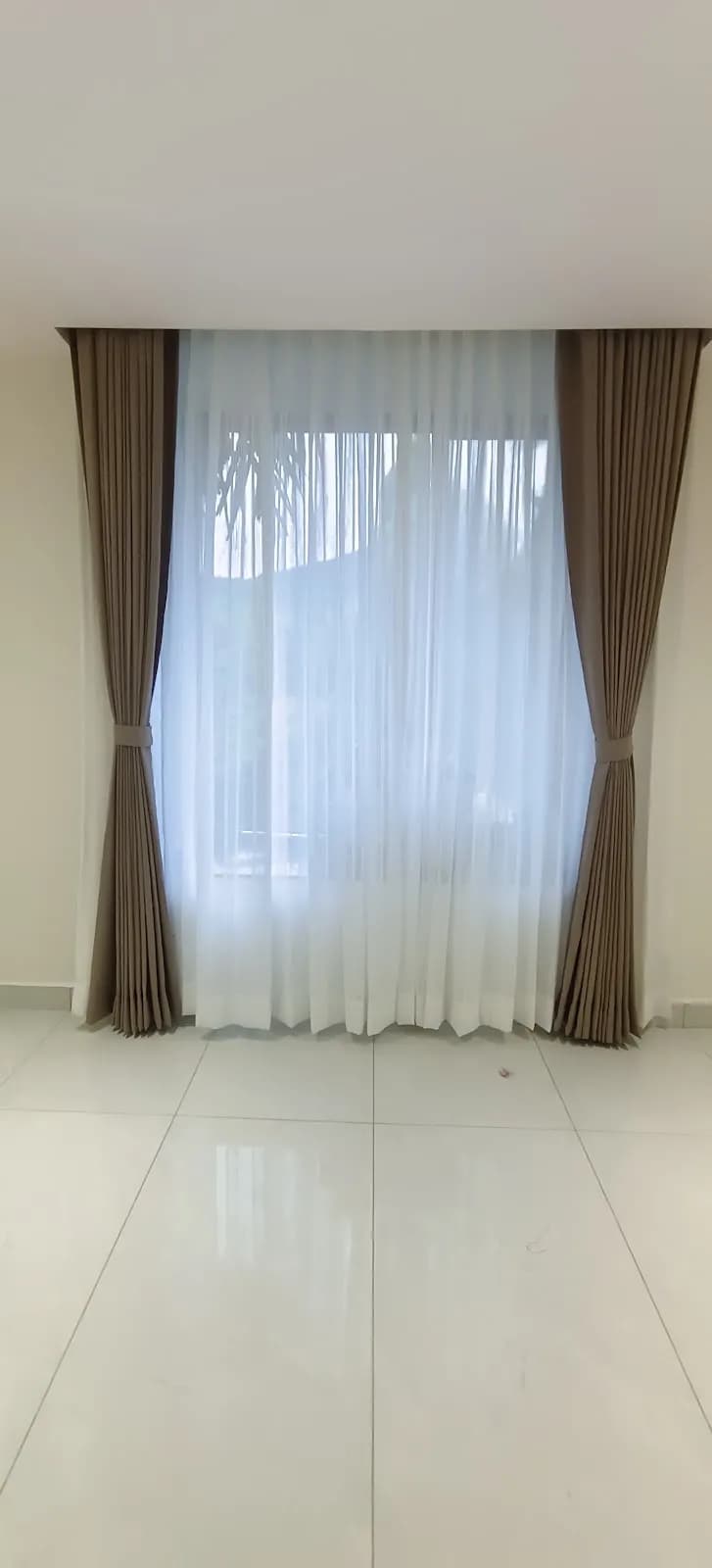
The double-track setup — sheer front, blackout back — handles every bedroom lighting need without changing hardware.
Why Bedroom Curtains Matter More Than Any Other Room's Curtains
Curtains in the living room are mostly decorative. Curtains in the bedroom directly affect how well you sleep, how you wake up, your circadian rhythm, and how private you feel in your most personal space. Get bedroom curtains right and your sleep quality visibly improves within a week. Get them wrong — thin fabric, wrong length, no blackout, ill-fitted hardware — and you'll be irritated every day for years.
This guide walks through the six decisions to make, in order:
- 1Blackout level (how dark do you want the room?)
- 2Fabric type (matches climate, aesthetic, budget)
- 3Layer configuration (single, double-track, triple)
- 4Header style (ripplefold, pinch pleat, eyelet, tab-top)
- 5Colour (works with wall paint, bed linen, floor)
- 6Measurement + install (get this wrong and nothing else matters)
We'll use real fabric choices from our /curtains collection with approximate 2026 India prices — but the principles apply for any curtain purchase.
Step 1 — Decide the Blackout Level Your Bedroom Actually Needs
Blackout curtain marketing suggests everyone needs 100% total darkening. The truth: different bedrooms need different levels. Match blackout to your actual needs:
Level 1 — Light-filtering only (sheer curtains)
Sheer polyester or sheer linen-blend. Softens harsh sunlight, provides daytime visual privacy from the outside, doesn't block bright light from reaching your bed. Sleeps light sleepers who wake naturally with dawn. Best for: guest bedrooms, secondary bedrooms with only ambient light, bedrooms in urban high-rises where full darkness feels claustrophobic. Fabric: approx ₹250/m for sheer polyester. See /curtains/sheer.
Level 2 — Medium darkening (single-layer thick fabric)
Medium-weight cotton, linen, or velvet without a blackout lining. Blocks about 60-80% of light — the room dims significantly but isn't pitch dark. Best for: bedrooms with only nighttime use, bedrooms with heavy tree-shade or building shadow blocking direct sun. Fabric options: Belgian linen approx ₹850/m from /curtains/linen; printed cotton approx ₹850/m; velvet 420 GSM approx ₹1,150/m from /curtains/velvet.
Level 3 — Full blackout (99%+ darkening)
Triple-weave blackout fabric OR a medium fabric with blackout lining. Blocks essentially all light — you can barely see your hand in front of your face. Best for: master bedrooms, kids rooms (for daytime naps), east-facing bedrooms (harsh morning sun), west-facing bedrooms (evening sun), shift-workers' bedrooms. Fabric: triple-weave blackout approx ₹950/m from /curtains/blackout.
Level 4 — Total blackout + thermal + acoustic (double-track with blackout back)
Sheer front for daytime + blackout back for night. Adds acoustic dampening (blocks street noise) and thermal insulation (keeps AC cooling inside). Best for: most Indian master bedrooms, city-facing bedrooms, hot-climate bedrooms. This is the setup we recommend to 80% of our bedroom customers.
The Sleep Science of Blackout Curtains
Research shows even small amounts of light exposure during sleep suppresses melatonin production and reduces deep-sleep quality. If you wake up feeling not-fully-rested despite 7-8 hours in bed, blackout curtains are a genuinely research-backed upgrade to your health.
Step 2 — Choose the Right Fabric for Your Climate & Aesthetic
Fabric determines drape, texture, longevity, and how the curtain performs in your climate. Here's the field guide for Indian bedrooms:
Sheer Polyester (approx ₹250/m from /curtains/sheer) — Light-filtering, budget-friendly, easy to wash, doesn't wrinkle. Best for daytime layer of double-track setup or standalone in guest bedrooms. Downside: purely functional, minimal luxe feel.
Belgian Linen (approx ₹850/m from /curtains/linen) — The most popular premium bedroom fabric. Breathable, naturally texture-rich, quick-drying — ideal for humid Indian coastal cities. Pre-shrunk so it doesn't warp after washing. Classic elegance that works in modern, mid-century, and traditional bedrooms. Downside: wrinkles more than synthetics (part of the aesthetic).
Printed Cotton (approx ₹850/m from /curtains/printed) — Custom digital or screen-printed patterns on cotton base. Perfect for bedrooms with a specific design vision — botanical prints, geometric patterns, or custom motifs. Best in dry climates or as the sheer layer in a double-track. Downside: cheaper cottons mildew in extreme humidity.
Velvet 420 GSM (approx ₹1,150/m from /curtains/velvet) — Ultra-luxury heavyweight velvet with acoustic dampening and thermal insulation. Rich jewel tones (emerald, navy, bordeaux, plum). Perfect for formal master bedrooms and home cinemas. Approximately 12 dB street-noise reduction. Anti-humidity treatment available for coastal homes.
Blackout Triple-Weave (approx ₹950/m from /curtains/blackout) — 100% light blocking without needing a separate lining. Thermal insulated. Best used as the darkening layer in double-track bedrooms. Downside: heavier than standard fabric, needs sturdy rods.
Silk & Faux Silk (approx ₹1,850/m) — The most luxurious option but demanding — best in dry climates and AC-controlled rooms. Not recommended for direct-sun windows (fades) or coastal humidity (deteriorates).
Not recommended for bedrooms: heavy jacquard (visually overwhelming in bedrooms), rough hessian/jute (uncomfortable near the bed), and pure PVC (unpleasant plastic feel in an intimate space).
Step 3 — Layer Configuration (Single, Double-Track, Triple)
How many layers of fabric hang at the bedroom window determines your daily flexibility. Three main setups:
Single-layer (one fabric)
One curtain fabric on one rod. Simple, affordable, minimal hardware. Best for: guest bedrooms, secondary bedrooms, bedrooms that don't get much direct sunlight. Choose either a mid-weight blackout for privacy-first, or a light-filtering sheer for softness-first.
Double-track (sheer + blackout — the Indian bedroom standard)
Two rods, one behind the other. Front rod holds a light sheer curtain; back rod holds a heavy blackout curtain. Draw the sheer for daytime privacy + softly-filtered light; draw the blackout at night for total darkness. This is our most-recommended setup — approximately 80% of the master bedrooms we install use this. Hardware cost is only marginally higher than single-track. Long-term flexibility is huge.
Triple-layer (sheer + midweight + blackout — luxury master suite)
Three layers — a sheer for daylight, a decorative midweight for evening ambience (velvet, linen), and a blackout for night. Reserved for luxury villa master bedrooms with wide picture windows. Requires professional installation and heavy-duty triple-track hardware. Not necessary for most homes.
Motorised tracks (add-on for any configuration)
Any of the above can be motorised — Somfy or Tuya smart-home compatible. Open/close via app, remote, or voice ("Alexa, close the bedroom curtains"). Popular in luxury villas and modern smart homes. Adds approx ₹4,500-8,000 per motorised track. Consult our /projects/smart-motorized-curtains-bogmalo-beach-resort-goa case study for a real installation walkthrough.
Step 4 — Choose the Right Header Style
The header is how the curtain attaches to the rod — and it dramatically changes the drape and modern-vs-traditional feel:
Ripplefold / Wave (modern, minimal)
Continuous smooth S-curve waves along the entire curtain top. The most modern, minimal, hotel-luxury look. Requires special ripplefold tape and matching tracks. Best for master bedrooms with a modern-minimal aesthetic, especially with linen and blackout fabrics. Small labour premium over other headers.
Pinch Pleat / Triple Pinch (classic, formal)
Deep gathered pleats every few inches — the timeless formal look. Works with any fabric, especially rich velvets and heavy jacquards. Best for traditional and heritage-style master bedrooms. Requires more fabric (fullness ratio ~2.2x vs 2x for ripplefold).
Eyelet / Grommet (casual, easy to slide)
Round metal eyelets punched into the curtain top, threaded directly onto the rod. Slides open and closed with a light touch — no tape, no rings. Best for kids bedrooms, guest rooms, and casual master bedrooms. Cost-effective and quick to install.
Tab-Top (very casual, traditional)
Fabric loops sewn along the curtain top, slid over the rod. Least formal look — best for bohemian bedrooms or budget setups. Downside: doesn't slide as smoothly as other headers.
Rod-Pocket (rustic)
A hemmed channel at the curtain top through which the rod is threaded. Ruched, rustic look. Doesn't slide well — best for stationary bedroom curtains that stay closed most of the time.
Use our /tools/curtain-fabric-calculator to estimate exact meters needed for your chosen header style — different fullness ratios (2.0x for ripplefold, 2.2x for pinch pleat) mean different total fabric requirements.
Step 5 — Colour That Works With Your Bedroom
Bedroom curtain colour should coordinate with your walls, bed linen, and floor — not fight them. Three foolproof strategies:
Strategy 1 — Match the wall paint (invisible curtain)
Curtains in the same colour as the wall visually disappear, making the bedroom feel larger and letting other elements (bed, art, wallpaper feature wall) be the visual stars. Best for small bedrooms and modern-minimal designs.
Strategy 2 — Complement the bed linen (coordinated palette)
Curtains in a colour that appears in your bed linen (through-pillow accent colour, throw blanket, headboard fabric). Creates a cohesive palette. Best for medium-sized bedrooms with a curated aesthetic.
Strategy 3 — Statement colour (dramatic focal point)
Bold-coloured curtains (deep navy, emerald, terracotta) as the room's visual anchor with everything else in neutrals. Requires confidence but pays off. Best for large master bedrooms with high ceilings.
Colours to generally avoid in bedrooms: Pure white (shows every dust speck), neon brights (visually jarring), and busy multi-colour prints (overstimulating in the room you sleep in).
Coordinating with wallpaper: If you have a feature wall wallpaper (like from our /wallpapers or /wallpapers/3d collections), pick a curtain colour that echoes a secondary tone in the wallpaper pattern — not the dominant colour (too matchy) and not a clashing colour.
Step 6 — Measure Correctly (The Step Most People Botch)
Wrong measurements are the #1 reason customer curtains don't drape properly. Here's how to get it right:
Track width (horizontal)
- ●If a rod is already installed: measure rod-tip to rod-tip.
- ●If installing new: measure the window frame width, then add 6-8 inches on EACH side. This lets the curtain stack fully off the window when open, showing the full glass.
- ●For picture windows or wall-to-wall windows: extend the rod at least 12 inches beyond the frame on each side.
Drop / height (vertical)
• Rod mounting height: typically 4-6 inches above the window frame top. For dramatic tall-ceiling villas, mount closer to the ceiling (creates a lengthening effect). • Curtain length options: – Floor-length (touching floor): most elegant, formal. Measure from rod to floor exactly. – Puddle length (2-4 inches puddling on floor): dramatic, luxury villa look. Add 2-4 inches to floor length. – Just above floor (1/2 inch clearance): modern-minimal, doesn't drag when opening. Subtract 1/2 inch from floor length. – Sill length: only for kitchen/utility windows. Don't use in bedrooms.
Fullness ratio
The curtain fabric must be wider than the track for proper draping. Rules: • Ripplefold header: 2.0x track width (i.e., 8 ft track needs 16 ft of fabric width) • Pinch pleat header: 2.2-2.5x track width • Eyelet header: 1.8-2.0x track width
Use our /tools/curtain-fabric-calculator — enter track width, desired header style, and drop, and it calculates exact fabric meters needed with proper fullness. This tool prevents the two most common mistakes: buying too little fabric (leaves gappy flat-looking curtains) or too much (wasted money).
Send us the measurements: Once you have track width and drop, WhatsApp both numbers + a photo of the window to +91 9579542260. We calculate exact fabric requirement, stitching cost, hardware, and today's exact quote — all within 24 hours.
Special Bedroom Situations
Kids bedroom curtains: Prioritise child-safety cordless mechanisms (no dangling cord for choking hazard). Blackout is essential for daytime naps. Choose stain-resistant fabrics (kids will grab curtains with sticky hands). Bold prints and cheerful colours work — floral, animal, geometric.
Elderly bedroom curtains: Prioritise easy operation (light-pull chains, motorised for high rods). Warm colours (amber, gold, warm cream). Sound-dampening velvet reduces disturbance from external noise.
Bedroom facing morning sun (east): Full blackout essential. Consider dual-layer with sheer front. Choose thermal-insulated blackout to keep morning heat out.
Bedroom facing evening sun (west): Blackout + UV-resistant fabric (velvet, blackout triple-weave). Fabric on the sun-facing side fades fastest — plan for possible fabric refresh in 5-7 years.
Small bedroom (visual-expansion tricks): Mount curtain rod at ceiling height (not just above window) — visually lifts the ceiling. Use light-coloured curtains matching wall paint. Avoid busy patterns and dark colours.
Villa master bedroom with tall/wide windows: Ripplefold or wave header for modern elegance. Motorised for convenience with tall rods. Consider triple-layer for full flexibility. Book a free in-home consultation across Goa via WhatsApp.
Your Bedroom Curtain Buying Timeline — From Idea to Installation
Step 1 — Measure (5 minutes)
Grab a tape measure. Measure track width and drop for each bedroom window. Note the wall colour and take a photo of the room with existing furniture.
Step 2 — Decide blackout level + fabric preference (30 minutes)
Read sections above. Decide: single or double-track? What fabric appeals? What colour?
Step 3 — Use our /tools/curtain-fabric-calculator (2 minutes)
Enter measurements + header style + fullness. Get exact fabric meters needed.
Step 4 — WhatsApp us on +91 9579542260
Send: measurements, blackout level chosen, fabric shortlist, colour preference, room photo. Our design consultant responds within 24 hours with: fabric recommendation, hardware quote, stitching estimate, and today's exact total price.
Step 5 — Free in-home fabric visit (Goa) or physical swatches (Pan-India)
Goa customers: our consultant brings full fabric albums + colour swatches + hardware samples to your bedroom. Pan-India: we courier 5-8 physical fabric samples of your shortlist within 3-5 days for testing in your actual bedroom lighting.
Step 6 — Order + stitch + install
Once approved: fabric is cut, stitched, hemmed with your chosen header. Standard turnaround: 7-10 working days. Installation: 2-3 hours per bedroom (Goa — free; Pan-India — comes with detailed install guide + hardware).
Related reading:
- ●/curtains — full collection with fabric catalog
- ●/curtains/blackout — blackout fabrics deep-dive
- ●/curtains/linen — Belgian linen collection
- ●/curtains/velvet — luxury velvet range
- ●/tools/curtain-fabric-calculator — instant meter calculation
- ●/blog — full library of bedroom, curtain, wallpaper, headboard guides
Need Custom Curtains Collection?
Order custom dimensions online for Pan-India delivery, or book a free site consultation in Goa with our senior decor team.
Frequently Asked Questions
Should I put blackout curtains in every bedroom?
Yes for master bedrooms and any bedroom facing morning sun (east) or evening sun (west). Blackout curtains improve sleep quality significantly by blocking 99%+ of light. For kids rooms, blackout is essential for daytime naps. Guest bedrooms and bedrooms with only ambient light can use light-filtering sheer + medium-weight combos instead.
What is the best curtain fabric for humid coastal bedrooms in Goa, Mumbai, Chennai?
Belgian linen (breathable, quick-drying) and velvet with anti-humidity treatment work best for coastal bedrooms. Also excellent: pre-shrunk cotton, printed cotton, and blackout triple-weave for the darkening layer. Avoid: heavy silk (traps humidity), unlined pure cotton (mildews), and untreated velvet (holds moisture).
How do I measure bedroom windows for curtains correctly?
Measure the WINDOW TRACK WIDTH (not the window frame) — this is the rod-to-rod distance if you already have a rod, or the finished mounted width. Add 6-8 inches beyond the window on each side for full-coverage stack. Measure the DROP (height) from where the rod will be mounted (typically 4-6 inches above the window frame) down to where the curtain should end (floor for elegance, or window-sill+2" for casual). Send both measurements + a photo on WhatsApp for a fabric requirement + cost estimate.
What is a double-track bedroom curtain and why do most Goan homes use it?
A double-track setup uses two parallel curtain rods mounted one behind the other — the front rod holds a light sheer curtain (for daytime privacy and filtered light) while the back rod holds a heavy blackout curtain (for night sleep and mid-day naps). This is the most popular bedroom setup in Goa, Mumbai, Bangalore, and other Indian cities because it handles every lighting need without changing hardware.
How much do bedroom curtains cost in India in 2026?
Fabric per meter typically ranges: Sheer polyester approx ₹250/m; printed cotton approx ₹850/m; Belgian linen approx ₹850/m; blackout triple-weave approx ₹950/m; velvet 420 GSM approx ₹1,150/m; silk/faux silk approx ₹1,850/m. Add stitching, headers (ripplefold/pinch pleat), and hardware. A typical 8ft × 8ft bedroom window in blackout linen typically costs approx ₹18,000-30,000 total. Actual prices vary daily by fabric, stitching, and market rates — WhatsApp for today's quote.
More on curtains
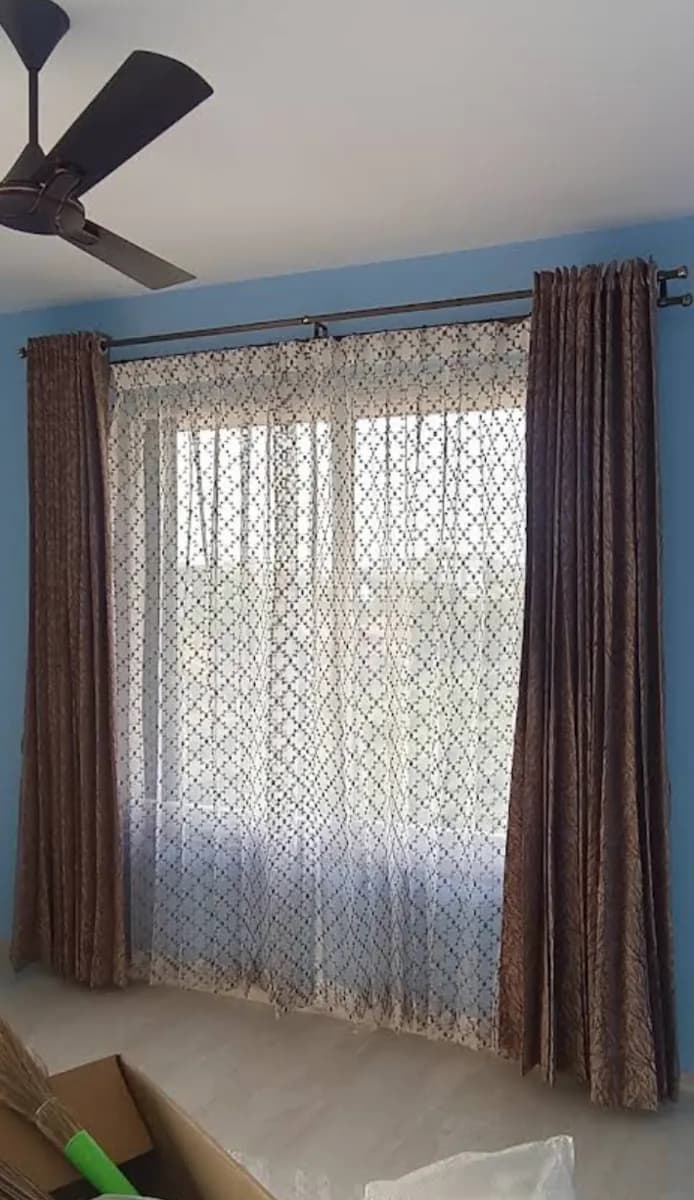
100% Blackout Curtains for Bedroom India: Light Blocking, Thermal Fabric & Price Guide
8 min read
Curtain Fabric Types & Material Guide: Sheer, Velvet, Linen & Blackout Fabrics
8 min read
Types of Curtains — 10 Popular Styles Explained (Sheer, Blackout, Linen, Velvet, Silk & More) | 2026 India Guide
14 min read